
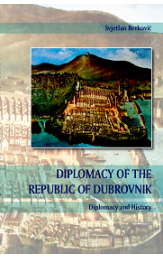
 The book treats the development of the diplomacy of Dubrovnik (Ragusa) and the State of Dubrovnik, tracing its history from the early beginning in the middle ages to the final downfall of the Republic of Dubrovnik in the early 19th century.
All major areas of international diplomatic and consular relations are depicted in this book, along with the organization and functioning of the foreign affairs service of the Republic of Dubrovnik and other relevant issues. The book contains, (along with numerous photographs), the following chapters:
- I. INTRODUCTION;
- II. HISTORICAL DEVELOPMENT OF DUBROVNIK – The period until 1358; The period from 1358 to 1526; The period from 1526 to the end of the 18th century; The beginning of the 19th century – the period of the French occupation and the abolishment of the Republic; Intents of the re-establishment of the Republic of Dubrovnik;
- III. GEOGRAPHIC AND ECONOMIC CHARACTERISTICS OF THE REPUBLIC –Territory (Geographical location; Acquisition of territory; Territorial organisation); Population (Domestic inhabitants; Foreigners and Refugees; Religion); Economic development (Economy; Trade; Maritime affairs);
- IV. THE STRUCTURE OF GOVERNMENT – The Grand Council; The Senate; The Minor Council; Rector: The Secretariat; Other governmental bodies; Legislation; Judiciary system; Military system; Financial system; State symbols (Flag; Coat of arms; Seal; Orlando's column);
- V. FOREIGN AFFAIRS OF THE REPUBLIC OF DUBROVNIK – The geopolitical position; Foreign Affairs principles; Relations with other states (Neighboring countries; The Hungarian-Croatian Kingdom; Austria; The Holy See; Spain; The Kingdom of Naples; Venice; Turkey; France; Russia; Examples of relations with other countries); The recognition of new states by the Republic of Dubrovnik (The recognition of particular states; The recognition of the USA);
- VI. DIPLOMATIC REPRESENTATIVES OF DUBROVNIK - Extraordinary (ad hoc) diplomatic representatives; Tribute ambassadors; Permanent diplomatic representatives; Appointment of diplomatic representatives; Letter of credence; Rank of the diplomatic representatives; Assistants of the diplomatic representatives; Famous citizens of Dubrovnik in Dubrovnik’s diplomatic service (IvanStojković; Vice Bune; Marin Getaldić; Stjepan Gradić; Ruđer Bošković);
- VII. THE DUBROVNIK’S CONSULAR SERVICE – The development of the consular service until the end of the 16th century; The consular service from the end of the 16th century until the abolition of the Republic; The appointment of consular representatives; The functions of consular representatives;
- VIII. MAIN CHARACTERISTICS OF THE OPERATIONS OF DUBROVNIK’S DIPLOMACY – Collection of information; Instructions; Cipher; Diplomatic mail; Ceremonial; Termination of mission; Foreign diplomatic and consular representatives in Dubrovnik;
- IX. EXAMPLES OF THE DIPLOMATIC RULES OF DUBROVNIK’S DIPLOMACY
- X. CONCLUSION.
Diplomacy of the Republic of Dubrovnik is of particular importance, not only to the Republic of Croatia, but also within the larger context of the European and even the world community. The Republic of Dubrovnik and its diplomacy stand as the cornerstone of the Croatian diplomatic tradition, marking at the same time the continuity of Croatian statesmanship in the Middle Ages.
The fact that Dubrovnik was abreast of time and very early developed a foreign affairs and diplomatic service isn’t widely known to the international public, moreover, the merits of laying the foundation of modern diplomacy are often attributed to other countries. It has to be noted that diplomacy of the Republic of Dubrovnik was one of the most developed services of its kind at the time, and it set its mark on the development of modern diplomacy, establishing diplomatic rules which are widely accepted around the world. For example, the Republic of Dubrovnik appointed and distributed its consuls before England did, and had more diplomatic representatives in the 16th century than Austria, introducing an abundance of rules and customs in the way of diplomatic correspondence and action, the organization of the foreign affairs service, the institution of the honorary consul etc. The inhabitants of Dubrovnik were very wise in assessing the political and general situation in order to preserve their independence, sovereignty and development through diplomatic means and skill. Although the Republic of Dubrovnik found itself in the focal point of interest of powerful states, it managed to maintain its independence for almost five centuries.
All the above mentioned induced the author to study in detail and make public, in English as well as Croatian, a close account of the diplomacy of the Republic of Dubrovnik which would contribute to the affirmation of the Republic of Croatia in its international diplomatic relations and its overall presentation.
The author, ambassador Svjetlan Berković LLD, is a very experienced diplomat who, during his many years of diplomatic service, has been appointed important diplomatic duties in his country and abroad. He is the author of many professional books and articles in the field of diplomacy and international law, a professor and mentor at relevant diplomatic institutions in Croatia and around the world, as well as the founder and first Director of the Diplomatic Academy of the Croatian Ministry of Foreign Affairs in Zagreb and the main initiator of the International Symposium “Diplomacy of the Republic of Dubrovnik”, held in Dubrovnik in 1997.
(„Diplomacy of the Republic of Dubrovnik – Diplomacy and History“ – ISBN 978-953-7393-02-1, 2009., ed. Urban Media Dubrovnik, 2009, pages 162)